Blocked nose

Blocked nose

Girl with blocked sinuses Having a blocked nose in pregnancy is quite common. Many conditions affecting the nasal passages and sinuses are sometimes caused by infection, e.g. common cold, or irritants, e.g. hayfever. Nasal infections are usually self-limiting but the symptoms can be uncomfortable and distressing. Recommended treatment aims to remove excess mucus and to alleviate congestion. Increasing fluid intake can help thin the mucus, steam inhalation may reduce the feeling of congestion and raising the head while sleeping can help to drain excess mucus.

Preventing and managing common complaints during pregnancy

Preventing and managing common complaints during pregnancy

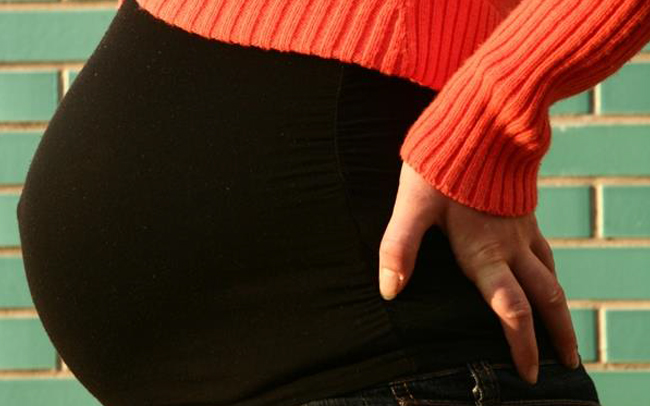
Close up of pregnancy bump with woman supporting her arched back with her hands

What complaints are common during pregnancy?

Pregnant women may experience one or more of the following symptoms:
  • back, pelvic, buttock or hip pain
  • rib pain
  • leakage of urine when coughing or sneezing
  • aching legs/cramps/varicose veins/swollen ankles
  • numbness and tingling in the hands
  • fatigue (extreme tireness)

Why am I more likely to experience these common complaints during pregnancy?

Hormonal changes

From early on in your pregnancy your body produces high levels of certain pregnancy hormones (called ‘relaxin’ and ‘progesterone’). These work to soften ligaments and muscles, especially around your lower back and pelvis, preparing your body for pregnancy and labour.

Weight gain and postural changes

Your body adjusts to the weight gain during pregnancy by changing your posture, for example, the way you stand. This can result in increased strain through some areas of your body. Strain is often felt around your lower back or pelvis.

Muscular changes

Your abdominal (tummy) muscles act like a corset to support your spine. During pregnancy, they soften and stretch slightly to allow your baby to grow. This can make them less effective in supporting your back and pelvis. Other muscles may also stretch or weaken during pregnancy, including your pelvic floor muscles which help to control your bladder and bowels. All of these changes are normal and allow your body to adapt to being pregnant, but they can make you vulnerable to aches and pains. The advice on the following pages will help you to be aware of the changes occuring and how to take care of yourself during pregnancy.

What can I do to help prevent aches and pains?

Look after your back

Think about your posture Doing this throughout your pregnancy can help to avoid and reduce pain.

1. When you are standing:

Try to avoid your ‘bump’ pulling you forward and over-exaggerating the curve in your lower back:
  • Tuck your chin in
  • Pull your shoulders back and down
  • Gently draw your tummy button towards your spine
  • Squeeze your buttocks slightly
  • Keep your knees relaxed and soft

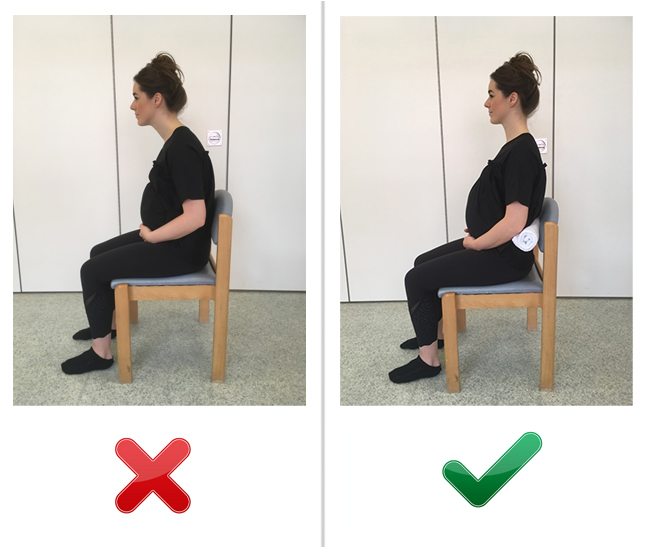
2. When you are sitting:

  • Try not to slouch
  • choose a chair that will provide your back with some support and ensure your bottom rests at the back of the chair. You may also wish to place a pillow or rolled up towel in the small of your back.
  • Make sure your feet are flat on the floor
  • try using a foot rest if they don’t quite reach. This will take the pressure off your spine.
  • As you stand up from a chair or bed, try squeezing your tummy and buttock muscles to provide extra support to your pelvis.
Woman shown sitting in chair incorrectly slumped forward then woman shown sitting with a rolled towel supporting her back

3. When you are lying down:

Woman lying on her side with a pillow between her bend legs
  • Lie on your side with a pillow between your knees (bending your knees comfortably).
  • You may find a pillow or small towel placed under your ‘bump’ supportive.
  • When turning from side to side, keep your kneeds bent and together, squeezing tummy and buttock muscle and moving in stages. Alternatively, turn onto all fours, keeping your buttocks clenched as you turn.

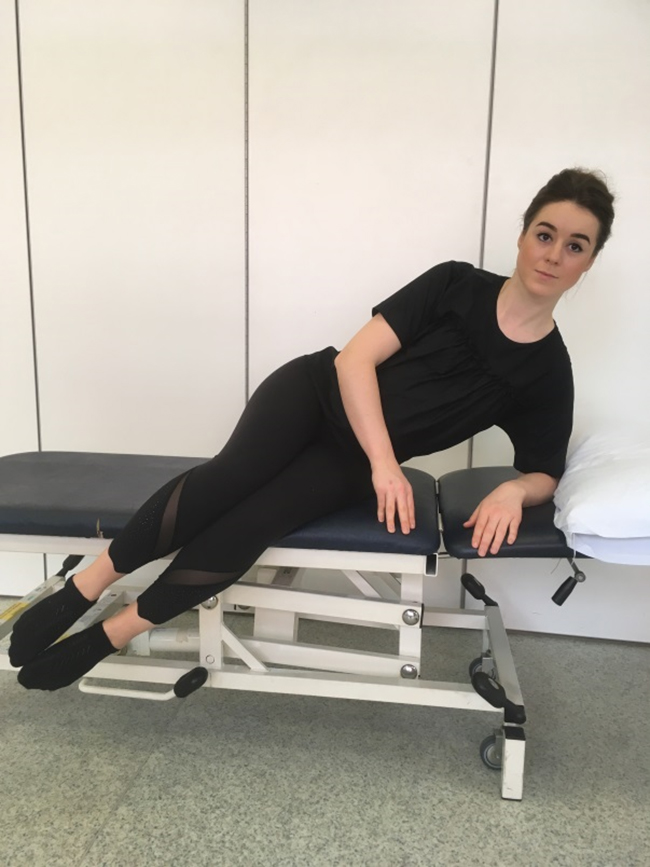
4. Geting in/out of bed

  • Bend your hips and knees together and remain on your side.
  • Squeeze your buttock and tummy muscles as you move.
  • Push up with your arms into a sitting position.
  • Do the reverse to get into bed or try climbing into bed on all fours.
Woman semi-reclining on one elbow with her knees and ankles bent demonstrating how to get in and out of bed

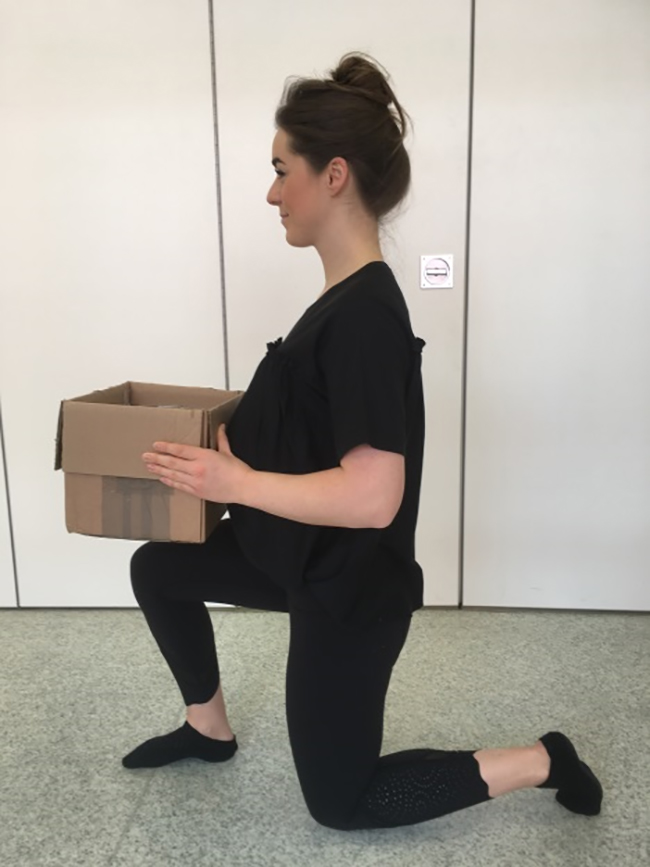
5. What about lifting?

  • Where possible, cut down on activities that involve bending, twisting and lifting, such as picking up small children and vacuuming
  • When lifting from the floor, bend down on one knee – see picture opposite
  • Keep a small stool to use in the kitchen to sit on instead of squatting down
  • Avoid lifting excess weight where possible – your body is already working hard to carry your baby
  • Shopping – try to avoid lifting out of deep shopping trolleys. When carrying larger loads, try to distribute the weight equally in each hand, or use a small backpack.
Woman bending down on one knee with her hands supporting a box on her raised bent knee to demonstrate safe lifting

Tips for daily life

  • Footwear
  • avoid heels more than 1 inch in height and try to have flat shoes with a supportive arch as they can encourage good posture.
  • Dressing
  • sit down to get dressed. This avoids standing on one leg, which can aggravate pain.
  • Ironing
  • make sure the board is a waist level to avoid prolonged stooping. Alternatively, sit down to iron if possible.
  • Cooking
  • sit rather than stand when preparing food.
  • Getting into a car
  • sit down first, keep your knees togeher and then swing both legs in at the same time (or slowly move each leg). Reverse this to get out of a car.

Keep your tummy muscles strong

Your tummy muscles stretch during pregnancy to allow your baby to grow and this is normal. The following simple exercises are safe to do during pregnancy and can help relieve back pain and improve the strength and function of your lower tummer muscles. If you are unsure about any of the exercises, please speak to a physiotherapist before starting them.

Transversus abdominus (deep lower tummy muscle)

This muscle wraps around your lower tummy and back like a corset to support the area. To strengthen this muscle:
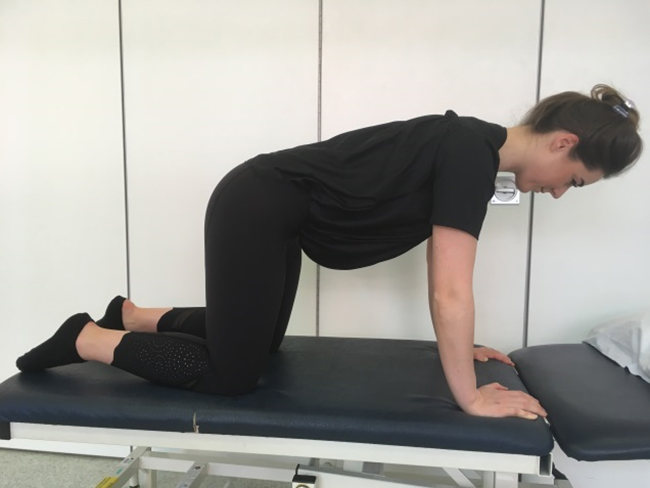
  • Begin on your hands and knees (all fours), keeping your shoulders over your hands and your hips over your kneeds – try to keep your back flat and still.
  • Breathe in, and as you breathe out, gently draw in your lower abdomen/tummy towards your spine.
  • Hold for 10 seconds, then release.
  • Repeat at least 10 times until fatigued.
  • Try to practice this two or three times a day.
Woman kneeling on all fours demonstrating lower tummy muscle exercise You can also do this exercise lying on your side, or when sitting or standing. You can exercise this muscle effectively when you are walking around or lifting and carrying. Just draw your tummy in as if you were hugging your bump or wearing a bikini!

Pelvic tilting

  • Stand with your back against a wall, with your head, shoulders and bottom touching the wall.
  • Bend your knees, keeping your heels shoulder-width apart, feet slightly sway from the wall.
  • Pull your tummy button back towards your spine and tuck your bottom under until you feel your lower back flatten against the wall.
  • Repeat up to ten times and do the whole exercise three times a day.
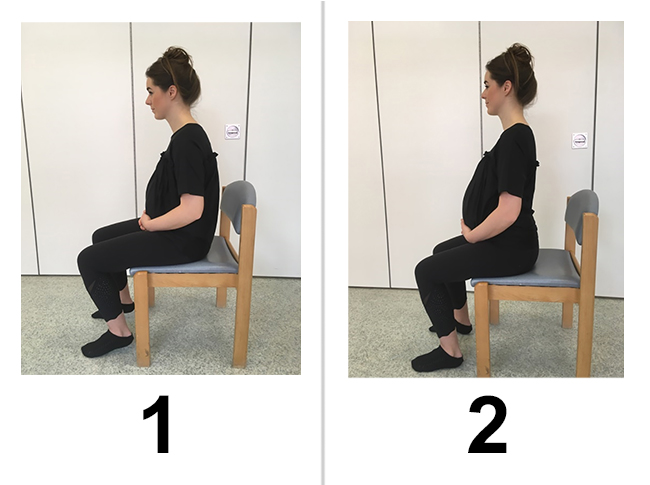
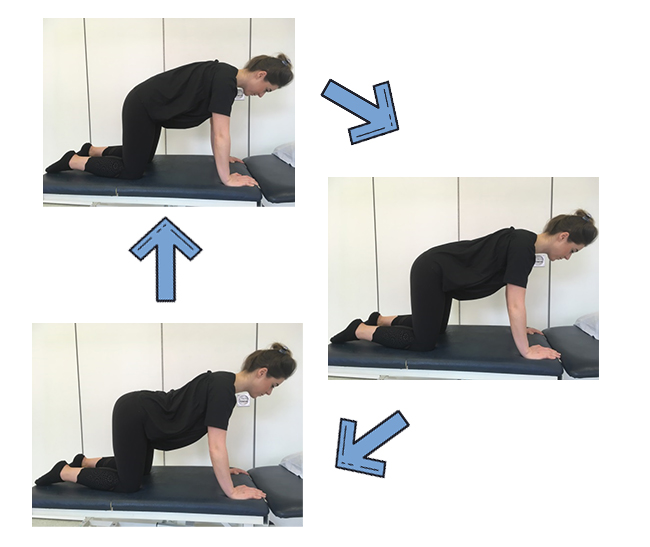
Woman sitting on a chair slightly slumped and then woman sitting on a chair with a straight back to demonstrate pelvic tilt exercise Alternatively, you can try doing this exercise in different positions, such as when kneeling, leaning on the bed, sitting (on a chair or exercise ball), or on all fours) see pictures 1-2 and a-c). Woman on all fours demonstrating pelvic tilt exercise by moving from an arched back to a neutral position then to a concave back

Keep your pelvic floor muscles strong

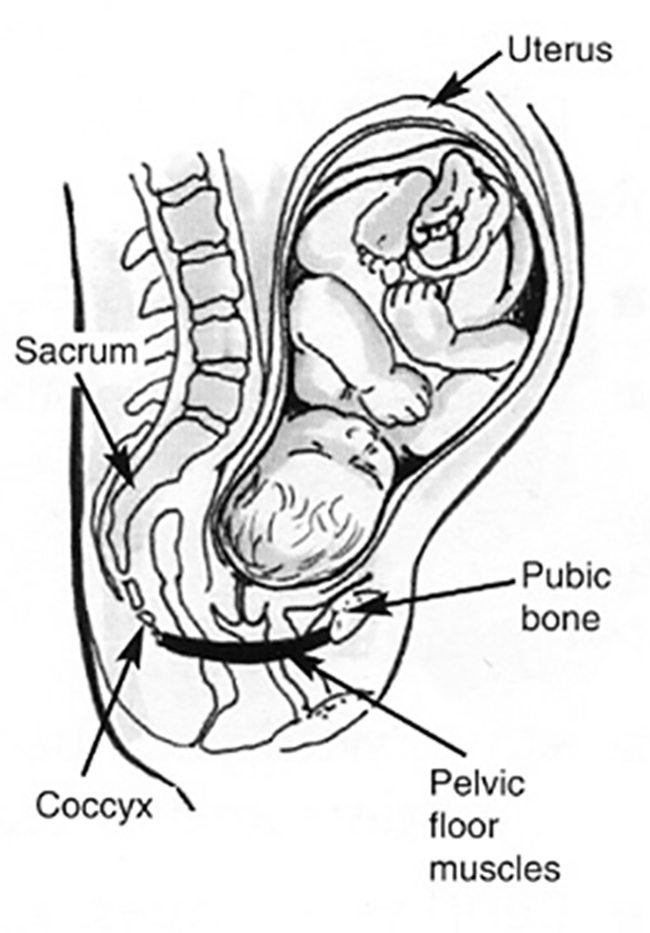
Your pelvic floor muscles lie between your public bone at the front and your coccyx (tailbone) at the back of your pelvis. They surround your anus, vagina and bladder openings. These muscles are like a platform that helps the pelvis to support the weight of your baby as it grows. They also maintain control of your bladder and bowels, and give support to the pelvic bones. During pregnancy, these muscles can be weakened by the weight of the baby, and are stretched during vaginal birth. Cross-section diagram of a mature baby in the womb to show where the pelvic floor muscles are located Some women may experience leakage of urine when coughing and sneezing (known as ‘stress urinary inconinence’) as a result of weak pelvic floor muscles. This is a common complaint affecting one in three women, but it can be prevented, reduced and even resolved fully with regular pelvic floor exercises. It is highly recommended that all pregnant and postnatal women regularly exercise their pelvic floor muscles even if they have no problems with bladder control, to prevent problems in the future. To begin with, you may have to concentrate while doing the exercises, but as you become more confident, you could do them whilst watching television, standing in a supermarket queue or waiting for the kettle to boil.

Pelvic floor exercises

Imagine you are trying to stop yourself passing wind and then pull forward as though you are also trying to stop your flow of urine. This closes and draws up the back passage and vagina. You need to exercise this muscle in two ways:

1. Slow holds

Hold the muscle in for as long as you can for up to 10 seconds. Release slowly and rest for at least 5 seconds between each one. Aim to do 10 in a row.

2. Fast squeezes

Squeeze the same muscles but quickly, releasing straight away. Aim to do 10 in a row. You can do these exercises almost anywhere and anytime but not when passing urine. In the beginning you will find these exercises easier to do when lying down or sitting. To train these muscles during and after pregnancy, try to get into the habit of doing both of the exercises 3-6 times a day.

Other helpful tips

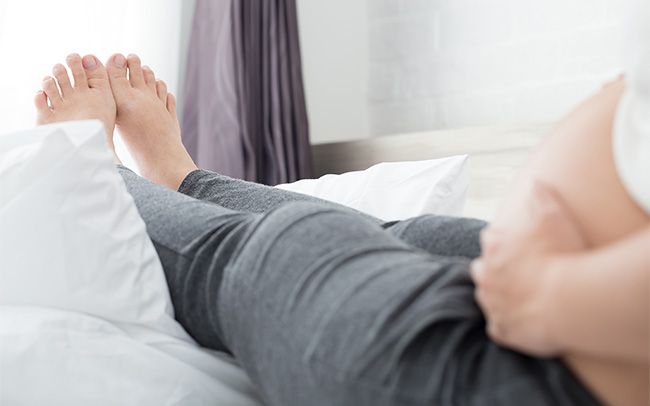
  • If you have swollen ankles or legs, make sure you spend some time with your feet up every day. Keep your feet moving and avoid crossing your legs. Wearing support stockings may help.
  • Sometimes women experience numbness and tingling in their hands. This can be due to excess fluid retention and often worse at night and first thing in the morning.
  • Try running cold water over your hands for a few minutes when you wake up – this helps improve circulation. Keep your hands moving, and massage your hands in the direction of your elbows. If this remains a problem, ask your midwife or GP to refer you to a physiotherapist.
  • It is hard work being pregnant, so listen to your body and rest when you need to. It is a good idea to spend some time relaxing regularly.

What about lower back and pelvic pain during pregnancy?

Lower back and pelvic pain during pregnancy are very common symptoms and are rarely due to a serious problem. Evidence suggests that 50% of women experience this pain during pregnancy. More than half of these women will complain that the pain impacts on their daily living. If you are starting to suffer from back or pelvic pain, make sure you are following all the advice and exercises previously listed on this page.

Pain relief

If your back continues to be painful, there are a number of other things you can do to help yourself. For example:
  • Put an ice pack (bag of frozen peas wrapped in a damp towel) or hot water bottle on the painful area for 1–15 minutes, several times a day. Avoid placing it directly over your abdomen (tummy) and protect your skin with a towel.
  • Relaxation and massage techniques can also help decrease the pain.
  • Keep active, as staying still for prolonged amounts of time can cause joints to become stiff and painful.
  • Talk to your pharmacist, GP or midwife about suitable pain relief to use during pregnancy.
  • You may like to try this gentle stretch, which may help to relieve your lower back pain.
Woman on the floor sitting back on her heels with her face towards the floor and her arms outstretched in parallel beyond her head Remember – it is not usually the one time we lift awkwardly or stand badly that causes pain; it is often the continual stresses and strains we place on our body during our everyday activities. Therefore, it is important to modify your daily activities using the techniques in this booklet, do some of the gentle exercises we suggest and ensure you pace your activities throughout the day and week. Please ask your midwife or GP to refer you to a physiotherapist if you are still having difficulties with pain.

How can I stay active?

Start by exercising the parts of your body most under strain during pregnancy. your back, tummy and pelvic floor muscles all need regular exercise to remain strong. Gentle low impact exercise, such as walking, swimming, yoga and pilates, is safe and highly recommended during pregnancy. Exercise encourages the release of hormones called ‘endorphins’ which help you to feel good, sleep better and reduce pain. However, there are some rules to exercise during pregnancy:
  • We advise that you avoid contact sports such as hockey/netball.
  • Be sure you warm up and cool down to avoid injury.
  • Make sure you do not get too breathless and can still talk in full sentences.
  • Replace, reduce or stop high impact exercises such as running and jumping.

What is perineal massage and how can it help?

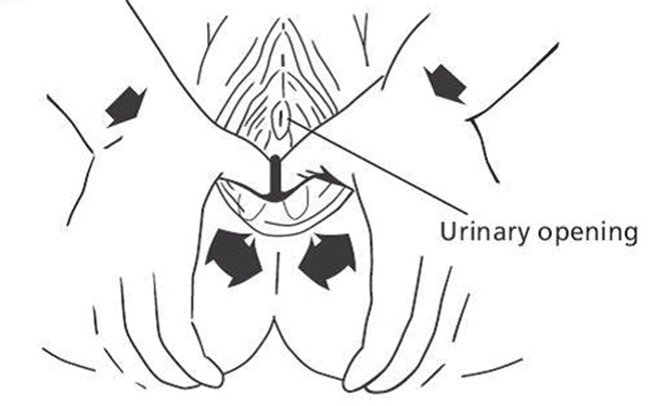
The perineum is the area between the vagina and the anus (back passage). Perineal massage is used to stretch the perineal tissue and scar tissue during late pregnancy. It may help to desensitise the area and reduce any pain. This may also help with a return to sexual relations. Diagram demonstarting hand positions when performing perineal massage

How to perform massage

Prepare

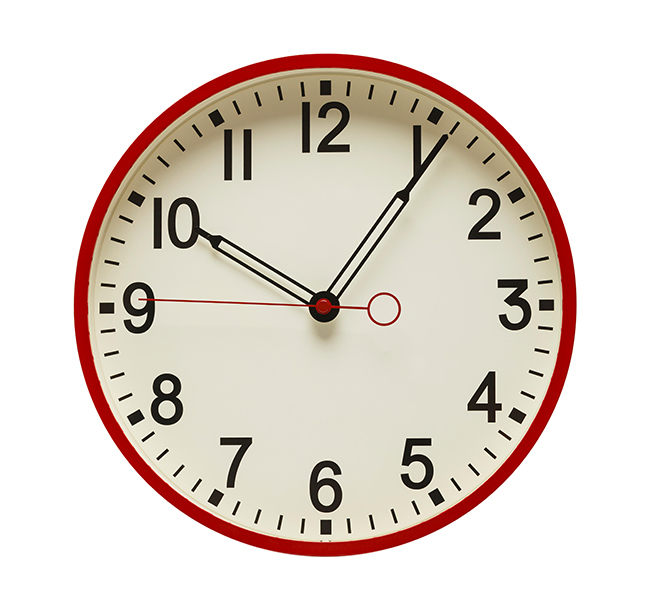
A mirror can help you to locate the area between the vagina and the anus so you know what you are doing. Imagine your perineum represents a clock face. Hands should be clean with nails clipped. Make sure your bladder is empty. Some women find having a warm bath beforehad can help relax and soften the tissue.

Position

Position yourself so that you are comfortable. You could try:
  • Squatting down (supporting yourself by leaning back against a wall or forwards on a bed or chair)
  • Sitting on the toilet
  • Standing with one foot raised on a chair/toilet
  • Leaning back or kneeling on all fours.

Technique

Lubricate your fingers well using a vegetable oil (such as almond or olive oil). Insert one or two fingers up to 2 to 5 centimetres into the vagina. Massage the oil into the tissues of the perineum and inside the vagina. To prepare the tissues, start by pressing towards the anus and then use a firm sweeping movement down and to the back. Imagine your fingers are sweeping like clock hands from 3 to 9. Continue this for 2 minutes maintaining pressure throughout. Clock face Following this, apply a firm pressure at 5, 6 and 7 on the imaginary clock. Hold each stretch until you feel a burning, stinging sensation for approximately 2 minutes. This technique may be painful/cause stinging sensation – this is normal. Try working in a circular montion with your thumb or fingertip across the scar and concentrate on one area of the scar at a time. Begin with a gentle pressure and build up as you feel comfortable. Massage can also be performed in the bath without addition of any oils.

Frequency

Aim to practice the techniques 3-4 times per week for between 5-10 minutes. Massage may be continued until the area is desensitised and less painful.

Further information

NHS Choices – exercise in pregnancy

Help and advice

If you have any concerns, or would like further advice, contact yoru local antenatal clinic, your community midwife or GP.

Acknowledgement

This content has been produced by the Department of Women’s Health Physiotherapy, Imperial College Healthcare NHS Trust and is used with permission.

Increased vaginal discharge
Increased vaginal discharge

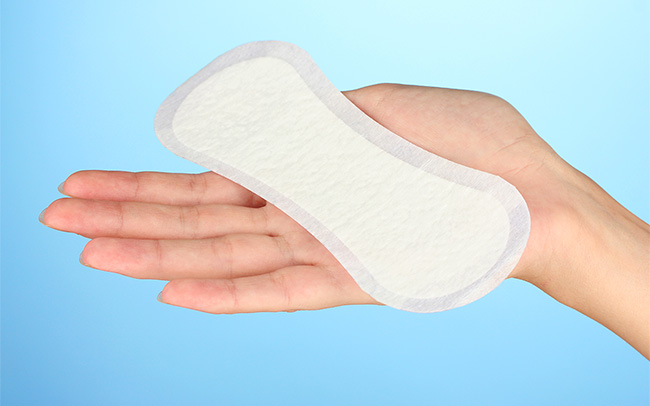
Close up of woman's open palm with a pant liner lying across it Normal vaginal discharge is thin, clear or milky white and mild smelling. As your pregnancy progresses, this discharge usually becomes more noticeable, and is heaviest at the end of your pregnancy. You may want to wear an unscented panty liner. If however, the discharge becomes very smelly or the colour turns green, then you should consult your GP, as this could be a sign of a vaginal infection. Thrush (candida albicans) is common in pregnancy. Symptoms of thrush include; vaginal discharge that is thick, white (or tinged with pink) and can be very itchy. Consult your GP or midwife as thrush is easy to treat with a vaginal pessary and cream.


Pelvic girdle pain

Pelvic girdle pain

Graphic of pelvic girdle bones with the lower front area coloured red to show one of the areas where pain can occur Pelvic girdle pain can affect one in five women during pregnancy. Pain can be in the front, back or side of the pelvis and is normally worse when you are active. It can cause mild discomfort for some, and be very debilitating for others. Try to keep your knees together when turning in bed, getting up from your bed and getting out of the car. Avoid putting excess strain on one side of the body during daily activities, if these activities cause pain. For example:
  • get dressed whilst sitting down
  • take stairs one step at a time
  • use a backpack instead of a handbag.
Ask your midwife about seeing a specialist women’s health physiotherapist if you’re experiencing problems with pelvic pain.

Constipation

Constipation

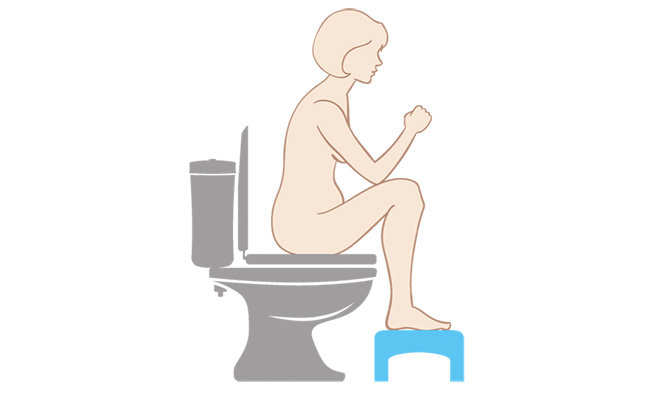
Graphic of woman sitting on a toilet with her feet placed on a low stool Constipation can occur from quite early on in pregnancy. Drink plenty of water, you will need between 1.5 to 2 litres of fluid per day. Ensure you’re getting lots of fruit, vegetables and fibre in your diet. When sitting on the toilet to empty your bowels, it is helpful to have your feet on a stool so your knees are higher than you hips and to lean forwards. This often makes emptying your bowels easier. Consult your pharmacist for advice if the problem persists.

Indigestion/heartburn

Indigestion/heartburn

Woman looking uncomfortable with her hand placed on her upper chest area Indigestion/heartburn is caused by hormonal changes, and the womb pressing on your stomach as your baby grows. There are plenty of home remedies you can try. Milk and/or antacids can help ease symptoms. If indigestion remedies don’t work and/or you have other symptoms, read the Heart health in pregnancy section and talk to your midwife or GP.

Headaches

Headaches

Woman in bed holding her forehead Headaches may increase due to hormonal changes. Drink plenty of water, rest and take paracetamol (1g) if required. Contact your midwife/doctor if you experience severe headaches (with/without problems with vision) that do not resolve with hydration, rest and paracetamol.

Feeling faint

Feeling faint

Woman looking unwell holding a glass of water It is common to feel faint or lightheaded in pregnancy and this is often caused by standing up too quickly or lying flat on your back. Always stand up gently and when lying down try to stay on your side, particularly after 28 weeks gestation. Keeping well hydrated can reduce feeling faint. If symptoms persist, talk to your midwife or doctor.

Incontinence

Incontinence

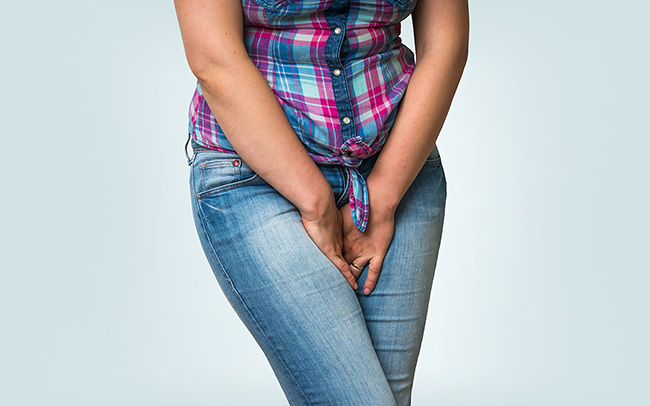
Close up woman in jeans with crossed legs and her hands on her groin area Incontinence can affect women during and immediately after pregnancy, due to the effect of hormones on the pelvic floor, and the pressure from the growing baby. Women may leak a small amount of urine when coughing, laughing, sneezing or moving suddenly. Should this happen, the first thing to do is to start your pelvic floor exercises daily. It is also helpful to contract your pelvic floor just before you cough, sneeze, lift, laugh or do an activity that causes a leak. Should the symptoms persist during pregnancy or more than six weeks after the pregnancy, ask your GP to refer you for specialist support. It is recommended that all women strengthen their pelvic floor during pregnancy to prevent and/or treat incontinence.