Transition to motherhood
Transition to motherhood

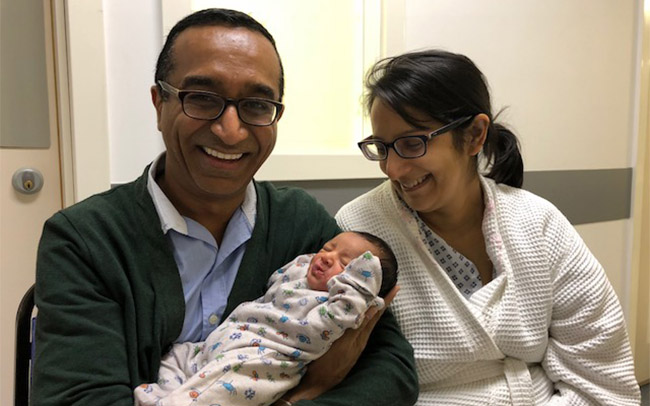
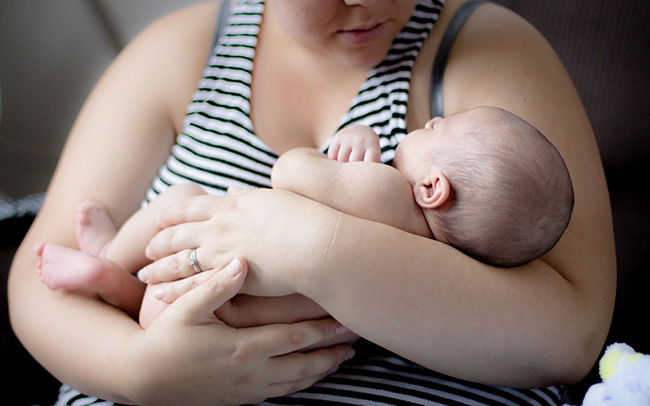
Woman holds her naked baby in her arms

The myth of motherhood

Having a baby is supposed to be one of the most exciting and happy experiences you’ll ever have. Women are expected to ‘blossom’ during their pregnancy and immediately fall in love with their baby. Society views childbirth as a time for celebration, fulfilment and hope. A woman is therefore under great pressure to act and feel in this way.

The truth about motherhood

Often the reality is quite different and you may be surprised to experience feelings you hadn’t expected. Childbirth can leave you feeling exhausted and anxious, as well as shocked by the sudden changes in your life as a result of becoming a mother. Instead of the expected happiness, many women struggle with the new set of demands a baby brings, the lack of independence and routine, together with the long hours of work within the home.

The transition to motherhood

Transition to motherhood involves adapting to physical, emotional and social changes and there is little support or preparation for this in our society. Therefore: Most mothers experience difficulties adjusting to their new role and may feel overwhelmed by the demands. Myths about motherhood can create unrealistic expectations. Therefore: Unrealistic expectations lead to feelings of failure when problems occur. “I remember wishing someone had warned me how hard it was going to be at first, but then I realised that even if they had it wouldn’t have prepared me.”

What type of support is available?

What type of support is available?

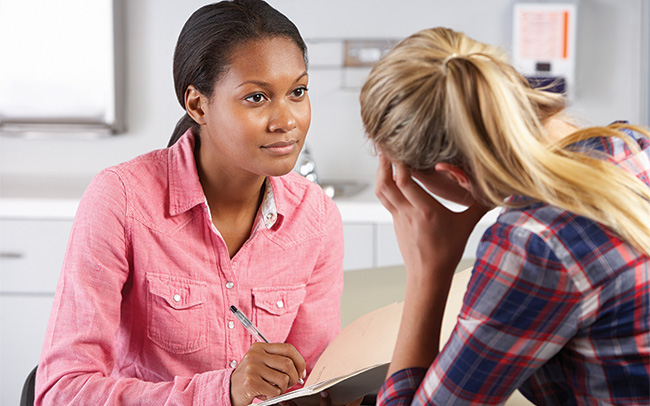
Woman talks with healthcare professional Women with mild to moderate mental health concerns are supported by a range of services; their GP, midwife, health visitor, primary care psychology service/talking therapy service and in places like Children’s Centres. There are many third sector organisations that also provide a range of support services, follow the related links to find out more. You can self-refer to all of these services. Women with more severe or complex mental health conditions, for example, severe anxiety, severe depression, psychosis and bipolar affective disorder, should be seen by a specialist perinatal mental health team. These teams are community based and are staffed by a range of professionals offering family focused interventions. These teams work closely with maternity services, health visitors, talking therapies, GPs, other community services and third sector organisations. Your midwife, GP or health visitor will refer you to your local perinatal mental team if more complex support for you is required.
Portal: What type of help is available? (Related link)

Self-help tips for postnatal emotional wellbeing

Self-help tips for postnatal emotional wellbeing

Women in group yoga class
  • try to sleep when the baby sleeps to minimise tiredness
  • spend as much time as you like cuddling and holding your baby – this has a soothing and calming effect
  • accept help with the baby from friends and family (it’s OK to take a break!)
  • improve diet by eating healthy foods and drinking plenty of water
  • light exercise, or just being outside in fresh air can enhance your mood
  • socialise (at local baby groups or Children’s Centres) to meet other parents
  • use the  Moment Health app to keep track of your mental health and alert you to changes in your mood.
Moment Health app

Getting help

Getting help

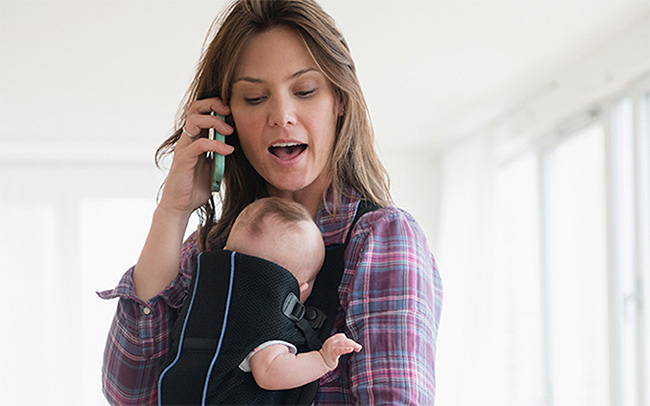
Mother making mobile phone call with in a sling strapped to her It can be difficult to talk about how you are feeling and ask for help. Common reasons for this are:
  • you may not know what is wrong
  • you may feel ashamed that you are not enjoying your baby or coping as you believe you should
  • you may worry that your baby will be taken away.
Asking for help doesn’t mean you can’t cope or are not able to care for your child. It’s the start of getting the right help and support to ensure you can be the parent you want to be. Try talking to someone you trust (friends or family) and contact your midwife, health visitor and/or GP to discuss how you are feeling. Your health care professionals are all trained to recognise postnatal depression and will be able to offer a range of support services to help you. Women with more severe or complex illnesses, for example, severe anxiety, severe depression, psychosis and bipolar affective disorder, should be seen by a specialist perinatal mental health team.

Postpartum Psychosis (PP)

Postpartum Psychosis (PP)

Woman in consultation with mental health care professional Postpartum psychosis (PP) is a serious mental illness which usually occurs in the first few days or weeks after childbirth. It diffes from baby blues or postnatal depression and should be treated as a medical emergency. Symptoms usually start quite suddenly within a few weeks after giving birth. Symptoms include:
  • hallucinations
  • delusions – thoughts or beliefs that are unlikely to be true
  • a manic mood – talking and thinking too much or too quickly, feeling high or on top of the world
  • a low mood – showing signs of depression, being withdrawn or tearful, lacking energy, having a loss of appetite, anxiety or trouble sleeping
  • loss of inhibitions
  • feeling suspicious or fearful
  • restlessness
  • feeling very confused
  • behaving in a way that’s out of character.
PP can be an overwhelming and frightening experience for you and your loved ones and it’s important to seek help as soon as possible. Women with a history of mental illness such as bipolar disorder are at particularly high risk of developing PP, however half of all women who develop PP have no history of mental illness. The symptoms of PP can get worse very quickly, so it should be treated as a medical emergency and usually requires hospital treatment. If you are experiencing symptoms of PP, call 999.   With the right support, most women fully recover from PP. Recovery takes time and the journey may be tough. The illness can be frightening for the woman experiencing it, her partner and family. See the related links below for more information.

Postnatal depression and anxiety

Postnatal depression and anxiety

Stressed mother holds sleeping baby Around one in seven parents will struggle with their emotional well-being and may develop postnatal depression or anxiety within the first year after childbirth. It can start very suddenly after your baby is born or it can develop slowly. Struggling emotionally at this time can happen to anyone. It is not your fault. You may experience on-going symptoms such as:
  • low mood, sadness and tearfulness
  • anxiety, worry and tension
  • feeling overly tired, tearful and irritable
  • difficult or unexpected feelings towards your baby
  • poor sleep even when your baby sleeps well
  • feeling unable to cope or enjoy anything
  • thoughts that you are not a good enough parent
  • worrying thoughts about your baby
  • feelings of hopelessness
  • struggling to come to terms with a difficult birth.
There is no single cause for postnatal depression or anxiety. It may arise because of a distressing birth, the shock of becoming a parent or other pressures (such as financial problems). If you have been experiencing any of the above symptoms for two weeks or more, you could have postnatal depression or anxiety. It is important to seek help as soon as possible from your midwife, health visitor or GP.

Antidepressants

Your GP may prescribe you a course of antidepressant medication. These are non-addictive, however they can have side effects, such as drowsiness, dry mouth or constipation. Antidepressants are usually well-tolerated and the majority of side effects improve following the first two weeks of treatment. The medication in itself does not cure the depression, but it can stabilise your mood efficiently to enable you to cope more effectively and to take advantage of other help. Most antidepressants take a few weeks to have any effect, so it is important not to give up too quickly if you don’t feel better straight away. If you are breastfeeding it is important that you inform your doctor so that this can be taken into consideration when choosing a suitable antidepressant. “Professionals from Children’s and Family Centres and other healthcare services helped a lot, but the single most important thing that got me through was meeting other mums locally and spending time with them and their babies. I wasn’t alone and other people felt the same as me. With the support and companionship of each other we got through the most difficult time.”

How partners, family and friends can give support with postnatal depression

If you think someone you love could be experiencing postnatal depression, then it is important to get help both for her, and yourself if you feel you need it. Your support is invaluable and there are a number of things you can do to help her become, and then stay well.

Partners

You are perhaps the most important person in terms of helping her to become well and stay well. Hopefully when she feels better you will feel that your relationship is stronger for the experience of going through this difficult time. The suggestions above can be helpful in addition to the following:
  • Reassure her that she will get well. As she starts to feel better it can be helpful to point out her progress to her, to encourage her that it won’t last forever and she will feel better soon.
  • Reassure her of your love and support, and that you are there for her. She will probably be feeling vulnerable and unlovable at the moment. If you find it difficult to express yourself you could leave her a note, take her a cup of tea in bed, send her a text message and think of different ideas of how to show her that you care.
  • Ensure that she gets enough food and rest. This is important for both of you.
  • You could ask her if there is anything she would really like to eat, and get it at the shops, or leave a prepared meal for her to heat up if you are at work. Offer to do some of the night feeds, if you can.
  • Encourage her to be active. The family could all go for a walk together, and look at making small changes like eating more healthily.
  • Point out any improvements that you notice in her well-being. This will help to give her the encouragement and hope to continue to make positive changes in her life.
  • Offer her a massage. You don’t need to be an expert, you could suggest giving her a back massage or a foot massage.
  • Go out together as a couple. Try to arrange to go out together without your baby or children. She may not want to do this until she is beginning to feel better so it is best to wait until she is ready.
  • Get help if you need it at any time. Don’t keep your problems to yourself. See the related links below.
Look after yourself. It is important to think about your own health and wellbeing and some of the suggestions may be useful for you also: “Before my wife had the baby she was fine but when the baby was a few weeks old she changed. She was either shouting at me or crying all the time and the house was a mess. I was getting blamed for everything. It wasn’t until our GP called me to explain that my wife was suffering wih postnatal depression that I realised there was a reason for her moodiness. I read up on postnatal depression and how I could help. I learnt that staying away from the house was making the situation rose and that my wife needed more support.”

Friends and relatives

  • Sensitively ask her what she feels she needs. She will probably have a good idea of what you can do to help her feel better.
  • Encourage her to talk about how she feels and ask to help. You can suggest that she approaches her midwife, health visitor or GP, or arrange to see whichever she feels that she can confide in. You could offer to go with her or arrange for them to see her at home.
  • Suggest that she joins a support group. Speaking to other people in a similar situation who know what she is going through can be a relief. This may not be something she wants to do at first but as things improve she may want to go.
  • Offer to help with childcare, to enable her to have time for herself.
  • Offer practical help, for example, to do the cleaning, washing, ironing or cooking to give her time to relax and get to know her baby.
  • Be patient, recovering from depression is a gradual process. Throughout, the early months of her feeling well again, she will probably still need your help and support.
  • Let her express her true feelings. Be as sympathetic as you can and treat her doubts and fears seriously.
  • Find out about postnatal depression, see below for more information.

Baby blues

Baby blues

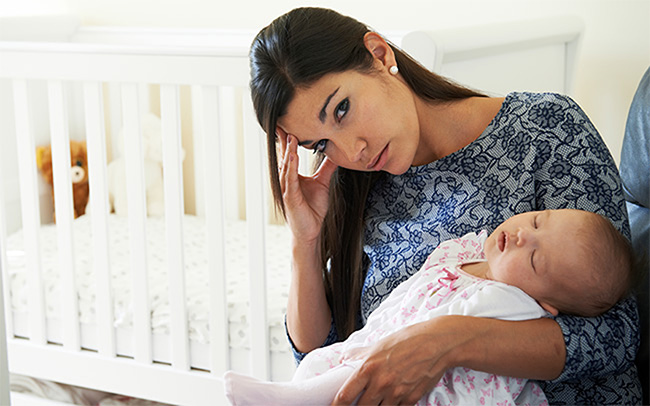
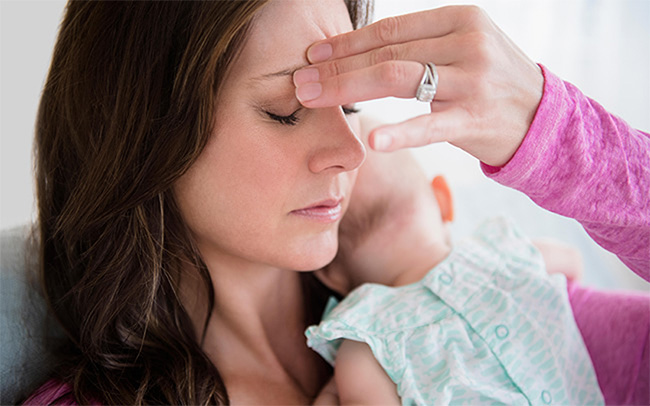
Woman presses her forehead with her hand while she holds her baby During the first week, the majority of women experience a short-lived change in emotions commonly known as baby blues. This is short period of feeling tearful and overwhelmed, often caused by a combination of exhaustion, life changes and hormones. This is very common and will only last a few days. Symptoms include:
  • feeling emotional and irrational
  • crying over seemingly small things or seemingly over nothing
  • feeling irritable
  • feeling sad or anxious
  • feeling physically exhausted and overwhelmed.
It is important to seek support from your family, friends and midwife during this time and try to get as much rest as possible. If you continue to feel low, or the bad feelings and thoughs get worse, speak to your health visitor or your GP.