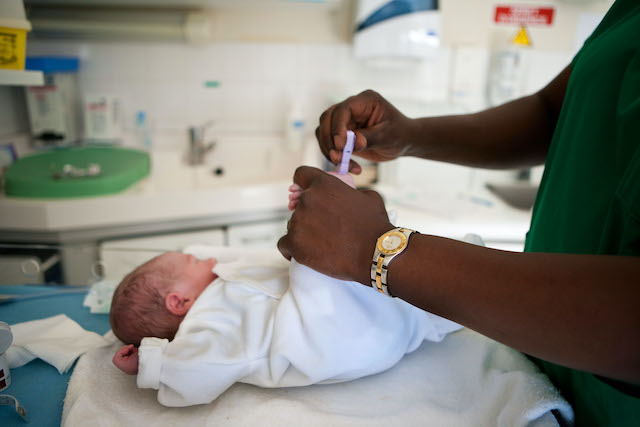
If you received antibiotics in labour only because of the known risk of GBS infection, this will be stopped at the time of the birth. For 12-24 hours after the birth, your team will monitor you and the baby for anything concerning, including signs of infection. The monitoring aims to identify early warning symptoms and signs. For the baby, this will include overall assessment and regular measurement of heart rate, respiratory rate, colour, temperature and feeding. The baby will stay with their mothers on the postnatal ward.
Signs of a possible infection
At birth, a baby doctor will review your baby’s risk of infection based on factors including your own signs infection, the course of your labour and an assessment of your baby. Your baby will be observed closely and have regular measurement of heart rate, respiratory rate, colour, temperature and feeding for at least 12 hours.Depending on the risk of infection, your baby may need to have some blood tests to look for infection and be started on antibiotics. In this case, the neonatal doctors will put a tiny cannula in your baby’s hand or foot so that they can take some blood to test and give the antibiotics directly into a vein (intravenous). If antibiotics are required, your baby will receive these twice a day through the cannula and the ward staff will continue to monitor your baby closely as before.Your baby can stay with you on the postnatal ward during this time. Should there be further concerns your baby may need to be admitted to the neonatal unit to enable close monitoring, further tests and necessary treatment. You’ll be able to visit your baby in the neonatal unit.
Why does my baby need antibiotics?
Antibiotics are started in babies assessed as being at significantly increased risk of infection. This is because infection in babies can be very serious if left untreated and even if your baby looks very well, they can become sick very quickly. The good news is that antibiotics can help keep your baby well.The antibiotics must be given directly into their blood stream as babies are not able to absorb sufficient amount of antibiotics from their gut. You will be able to breastfeed your baby and the ward staff will support your feeding choices.We want you to know that there are normally no side effects or allergic reactions with use of antibiotics in newborn babies. If you are unsure why your baby needs antibiotics, please ask the medical team to explain this to you.Whilst you will have to be careful with the cannula when holding your baby, you will be able to do skin-to-skin and breast feed your baby.
What tests will my baby have?
If your baby requires investigation for infection, a number of blood tests will be performed, including:
1) CRP (C-reactive protein), which is produced by our bodies in response to an infection or inflammation. A high CRP can indicate the presence of an infection in the body.
2) Blood cultures to identify if any bacteria are growing in the blood. This result may be available within 36-48 hours of the test.
After 18-24 hours from birth, the CRP test will usually be repeated by collecting a small amount of blood from a heel prick.If at any stage your baby’s health or any of the results are a concern, they may need more tests like a chest x-ray and/or a lumbar puncture to work out the site of infection and will require a longer course of antibiotics. The neonatal doctors will discuss this with you.
How long will my baby need antibiotics?
The length of time your baby needs antibiotics will depend on how your baby is doing and what the results show.If your baby remains well, the CRP is not high and the blood cultures do not grow any bacteria, the antibiotics can usually be stopped after 36-48 hours. A longer course of antibiotics may be indicated should there be any concerns.
When can we go home?
At the time of birth, it is difficult to know when you and your baby will be able to go home. After 36-48 hours, the doctors will have a better idea of the duration of treatment required. Your team will continue to review you and your baby on the ward daily until they feel sure that you are both well enough to go home.On discharge from the hospital, you will receive written information about the medical treatment delivered on the ward. You can share this with your community midwife and health visitor. Your GP will be sent this information.
Guidance for next pregnancy if you or your baby was identified as having GBS
If you become pregnant again, please inform the maternity care team looking after you that about the positive GBS result, so that they can offer antibiotics in labour to reduce the risk of early onset GBS infection in the baby.
What should I do if I have worries?
Ongoing maternity care is provided by community midwife, who are local to where you will be based after discharge from the hospital. The community midwife will make contact with you within 24-48 hours of being at home. They will support you and your baby’s care.Should you have any urgent concerns regarding the health of you or your baby, please seek medical advice from your GP, NHS 111, 999 or attend your local Accident and Emergency department. For baby, these concerns may include baby showing abnormal behavior (for example, inconsolable crying or listlessness), being unusually floppy, has an abnormal temperature unexplained by environmental factors (lower than 36 or higher than 38 Degree centigrade), abnormal breathing (rapid breathing, difficulty in breathing or grunting) or change in skin colour (for example baby becomes very pale, blue/grey or dark yellow) or has developed new difficulties with feeding.