Around 15% of babies are born by emergency caesarean section, either during pregnancy or labour. You may need an emergency caesarean section if:
your baby’s head is too big for your pelvis, or in the wrong position
your labour doesn’t move on, your contractions are weak, and your cervix hasn’t opened enough
your baby is distressed, and labour hasn’t gone far enough for you to have a safe forceps or ventouse delivery
you develop a serious illness, such as heart disease or very high blood pressure
for some other reason your baby needs to be born quickly, for example because of placental abruption (where the placenta separates too soon).
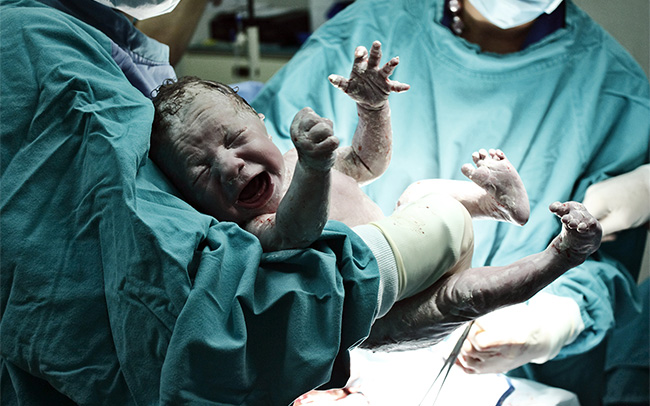
Most women will have an epidural or spinal anaesthetic to ensure they do not feel the operation, however in some cases where the pain relief isn’t adequate, or there isn’t enough time to put the spinal in, a general anaesthetic might be advised.The obstetrician will make a 10 to 15cm cut at the bottom of your abdomen, just at the top of your pubic hairline, which is big enough to deliver your baby through, then a cut through your womb to reach your baby, usually after a delay of one minute. You may feel some tugging when your baby’s lifted out – sometimes this is done by hand and sometimes with a pair of forceps.Your baby will have have their umbilical cord clamped and cut, be quickly checked over by the baby doctor, and if everything is well they’ll be passed to you or your partner, so you can hold them and have skin-to-skin contact. The placenta and membranes are delivered then the cut in your womb and abdomen are closed with stitches.It normally takes about 10 minutes to deliver your baby, and 30 to 40 minutes to complete the stitches.There are some associated risks with caesarean section delivery, for both you and your baby and your team will discuss these risks with you prior to the surgery.Recovery from emergency caesarean is the same as recovery from a planned caesarean.

 Around 15% of babies are born by emergency caesarean section, either during pregnancy or labour. You may need an emergency caesarean section if:


