During your pregnancy there is so much information to read, access and try to make sense of. In Lincolnshire we have worked hard to design purpose made short films to assist you with all the decisions you have to make. Alongside our organisation we hope that by accessing these films we will help support you by signposting services, offering information on various topics and altogether help you on your journey to parenthood.
You can access all of the antenatal videos by clicking the link below.
The Physio Team from Lincolnshire Community Health Services have produced a series of videos to demonstrate safe exercises during pregnancy. These videos can be accessed by clicking the link below.
The Antenatal Pathway is also now ‘Live’ on the Better Births website which highlights services, information for families and supports families on their pathway to help them make informed choices. Please click on the link below to access this:
Your Pregnancy Journey – The Booking In Appointment
Better Births: Personalised Care and Choice
Better Births: Continuity of Carer
Your Pregnancy Journey – Homebirth
Your Pregnancy Journey – Pilgrim Hospital Virtual Tour
NHS Your Caesarean Birth Journey – Better Births Lincolnshire
The Continuity of Care Team Gainsborough have also developed some short films to help during the pandemic for those that could not access Antenatal Education classes – take a look.
Place of Birth and Birth Preparations
1st, 2nd and 3rd Stages of Labour
It can be helpful to review events around pregnancy and birth. In Lincolnshire all maternity units have a birth reflection/listening service that can be accessed at any time after giving birth or when you return for subsequent pregnancies. To find out about how to access this service, speak to your community midwife.
Breastfeeding your baby can be one of the most rewarding experiences for some mothers, but like anything new it can take time to master. Here are some helpful short films produced by the local organisation United Lincolnshire Hospital Trust’s maternity team, in particular our Infant Feeding Specialist, along with some useful contacts for our local area.
Some of the groups and activities on offer at Lincolnshire’s Children’s Centres are detailed below. If you are interested in any of the groups/activities listed below or would like to find our more information, then please contact the Children’s Centres using the contact details above.
BreastStart:
Members of the Children’s Health 0-19 Team offer breastfeeding support across Lincolnshire in the form of BreastStart Groups which take place at Children’s Centres. The groups are a fantastic opportunity to get advice, support and make contact with fellow breastfeeding parents. Contact your local Children’s Centre to find your local drop in BreastStart group.Members of the Children’s Health Team can also offer bespoke support with all aspects of infant feeding. To speak to someone please contact them on the telephone number above.
3-4 Months, ‘Top Tips’
3-4 Months ‘Top Tips’ is a relaxed and informal session delivered by Early Years Practitioners at Children’s Centres across Lincolnshire. These drop-in sessions are FREE and include top tips about introducing solid foods, oral health, accident prevention and age-appropriate development. It’s a great opportunity to meet new families and find out what local services are available for your family.
Baby Massage
Lincolnshire Children’s Centres offer a FREE 5 week ‘Baby Massage’ course for you and your baby. Baby massage is a lovely way to spend time and bond with your baby in a relaxed environment.
Each maternity unit in Lincolnshire Maternity & Neonatal System offers three locations for birth: home, midwife led unit or obstetric led unit, please talk to your midwife to discuss your choice.
Within Lincolnshire if you choose to birth and/or labour at home you may wish to have the use of a pool. if so please click on the link to find out how you can hire one for your home
Lincolnshire Maternity and Neonatal hospitals include these core services:
birthing pools
obstetric-led care
midwife-led care
infant feeding specialists
consultant cover
home birth option (see below)
specialist diabetes clinic
ultrasonography services
antenatal ward
antenatal care in the community
local neonatal care (see below for more details)
postnatal ward
postnatal care in the community
postnatal care at home
perinatal mental health specialists
maternal mental health specialists
‘Preparation for Parenting’ antenatal classes – virtual (see below for more details)
Personal care
As your pregnancy progresses, your personal wishes or needs may change. Your midwife and/or obstetrician will explore your options with you and help you with any new decisions you need or want to make. See these short films relating to some aspects of antenatal care which may be of use.
These classes are delivered virtually. More information about the classes, dates and how to register can be found here.
Home birth
Please speak to your midwife if you would like more information about having a home birth.For more information about hiring a birth pool and/or TENS machine for your home birth, please click the link below.
Neonatal services in Lincolnshire and the surrounding area vary in that they offer specialised care to babies born at different gestations. Where possible you and your baby will be advised to attend the most appropriate hospital for care if there are risks of premature birth. However, in some circumstances, and for your own safety and well-being you may have to be transferred to another unit following birth for specialised care for your baby. If you are pregnant and have been told that you may be at risk of delivering early you can be offered a ‘show round’ of the Neonatal Units in the hospital of your choice to become more familiar with the setting. Ask your midwife and this can be organised for you and we can support you through this.
Lincolnshire was the first NHS Local Maternity System to have an effective and working Neonatal Parent Voice Group. This group consists of mothers and fathers who have experienced premature births of their children and who could be of use as a support. Please go to the links below for additional information and virtual tours of the Neonatal Units.
Ask your midwife or health visitor about your local Maternity Voices Partnership group. These groups consists of mums-to-be, new mums, midwives, doctors and other allied health professionals who meet to discuss, learn and help share ideas for improved services across Lincolnshire.
Hospital charities raise money via fundraising activities for patients and staff and by coordinating and receiving charitable donations. Money raised is re-invested into service improvement projects. To find out more about your local NHS hospital charity, follow the link below:
Women and their families are encouraged to provide feedback via our purpose-built feedback website. This information collected on this website is taken directly back to our hospitals to ensure continued improvement of services.
Lincolnshire has a Local Maternity & Neonatal System board which meets once bi-monthly to work together in driving maternity improvements across the sector. Visit the better birth Lincolnshire website to find out more about how you can get involved in health improvement projects in your area.
In Lincolnshire we have developed a postnatal discharge film in collaboration with the organisation to help you when you are discharged home. This can be a daunting and exciting time but again it may feel like there is so much to remember so a short film may help with those worries. Please see the links below:
Reducing Parental Conflict
Arguments and conflicts in relationships happen to all of us. For some people, the reality is that they are unable to resolve these arguments. We know there are many different reasons for conflict in families and we are working hard to make families aware of the support on offer. Click below to access support in Lincolnshire:
This free online course is offered to help new and expectant parents adapt to the changes that parenthood can have on their relationship, raise awareness of the impact of stress and support parents to develop skills to manage conflict constructively.
Arguments and conflicts in relationships happen to all of us. For some people, the reality is that they are unable to resolve these arguments. We know there are many different reasons for conflict in families and we are working hard to make families aware of the support on offer. Click below to access support in Lincolnshire:
This free online course is offered to help new and expectant parents adapt to the changes that parenthood can have on their relationship, raise awareness of the impact of stress and support parents to develop skills to manage conflict constructively.
Your midwife or health professional can assist you with this.
A localised version DadPad is available for families and partners for Lincolnshire. This is an invaluable information tool for partner’s to help and guide them in the early days of becoming a parent. It offers them a chance to be well informed and enables partners to feel more involved and be of support to women when preparing for birth and the intense weeks and months that follow after birth. Download the free app from the Apple App Store or GooglePlay and enter your postcode to access specific Lincolnshire information:
We are excited to introduce the new Military Maternity Voices Partnership (MMVP) which is aimed at supporting military families living in Lincolnshire.To find out more about this exciting new project and the Lincolnshire Maternity & Neonatal Military Care Programme please click on the link below to watch a short video.
Ask your midwife or health visitor about your local MVP group. These groups consist of mums-to-be, new mums, midwives, doctors and other allied health professionals who meet to discuss, learn and help share ideas for improved services across Lincolnshire.
Lincolnshire was the first local maternity system to have an effective and working Neonatal Parent Voice Group. This group consists of mothers and fathers who have experienced premature births of their children and who could be of us as a support. Please visit the websites below for additional information and virtual tours of the Neonatal Units.
Maternity care in Lincolnshire Local Maternity & Neonatal System
This app, originally developed by North West London Local Maternity System, has been adapted for use in Lincolnshire Local Maternity & Neonatal System.
If you live outside of Lincolnshire, you can still use this app’s content and develop your personal care plans. To find your nearest unit follow this link:
The Lincolnshire Partnership NHS Foundation Trust (LPFT) supports our women and families, working in tandem with many services to ensure that our families are cared for appropriately. This includes services to help support mental health and awareness, as well as health visiting advice.
The single point of access line number can be used to access advice and also to request mother and baby vitamins during pregnancy for those families that require additional support.
Steps2Change provides talking therapies for people 16 years and older experiencing problems with anxiety, depression, stress, and offers help with issues like bereavement or the impact of a traumatic event.
If you feel that you would like to access talking therapies you don’t need to make an appointment with your GP or healthcare professional. Find out more here:
The Maternity and Neonatal Safety Improvement Programme (MatNeoSIP)
This project aims to improve the safety and outcomes of maternal and neonatal care by reducing variation in practice and providing a high quality healthcare experience for all women, babies and their families across England.
PReCePT (Prevention of Cerebral Palsy in Preterm Labour)
The PReCePT programme aims to reduce the incidence of cerebral palsy in babies born prematurely by giving women a medication called magnesium sulphate during labour. This programme is being rolled out across North West London and other activities include improving care, strengthening staff capability across maternal and neonatal units and supporting mothers to become more involved with their care to improve quality of life of preterm babies and their families.
To find out more and to get involved with either of these projects please contact us.
Please visit the links above for lots of information for Lincolnshire following the birth of your baby, including a short film by our specialist maternity physio regarding pelvic health after birth.Are you:
16 weeks or more into pregnancy?
in your first year of motherhood?
suffering pelvic/low back pains
suffering small leakages
experiencing a weak core
seeking advice to return to exercise/work
For confidential help and advice, self-refer into the new community women’s health physiotherapy service by visiting this website:
Smoking and reducing the rates of smoking within the local area have been high on the agenda for Lincolnshire and the Better Births team. This short film has been created by the team to help support and encourage families to stop smoking.
Talking therapy services or IAPT services are offered throughout Lincolnshire providing support to those experiencing symptoms of anxiety or depression. Priority is given to pregnant women and new parents. You can either self-refer over the phone or online, or ask your midwife or GP to do it for you. The service is free and aims to be flexible around your needs.
"Our vision is to lead the way in providing maternity care that not only is safer and more personalised, that offers choice and is fundamentally friendlier for families, but that strives towards a greater vision for the future. In following the recommendations laid out in the National Review in 2016, Better Births Lincolnshire has been operating over the past three years, with a move towards a new model of care now in Lincolnshire, which represents a fundamental review of the way that services have been organised and delivered. If implemented effectively, this will mean improved outcomes for both the health of women and their families now, and for generations to come.
"In looking forward it is essential that our focus is on ensuring that every woman has care delivered as close to home as possible through local community midwifery teams and expansion of the community hubs.
"We recognise that achieving our local vision will be challenging, but we have established a
Local Maternity Neonatal System (LMNS) with the leadership, governance and the clinical commitment required to secure the delivery of safe and improved maternity care in Lincolnshire."
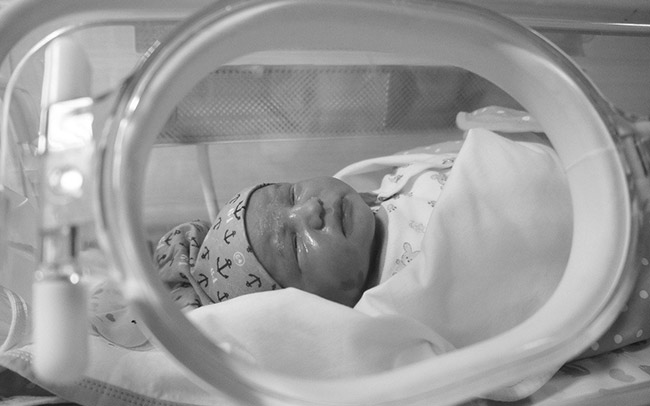
In Lincolnshire Maternity & Neonatal System, all our main maternity units have Neonatal Unit (NNU) facilities to provide enhanced care for sick and preterm babies. Not all of our units have an onsite neonatal intensive care unit (NICU), but the Trusts are linked via a neonatal network to ensure that when a baby needs intensive care it can be transferred to the nearest NICU.
It can be a scary time for families if you are told that your baby might come early or even if there is a risk that your baby may come earlier than your due date. But here are some helpful short films produced by the Lincolnshire Better Births team and extremely active Neonatal Parent Voice group that will hopefully make things clearer for you.
Neonatal care
Premature babies and neonatal care -radio interview
The voice of our neonatal parents
Lincoln Neonatal Unit
Boston, Pilgrim Neonatal Unit
The East Midlands Neonatal Operational Delivery Network (EMNODN) also link with the organisation in relation to the safest options for mum and baby when a baby is born early. Here are some more helpful links and information to support you if your baby is in the Neonatal Unit.
NHS Better Births Lincolnshire Baby Movement – Myth Busting
Midwife
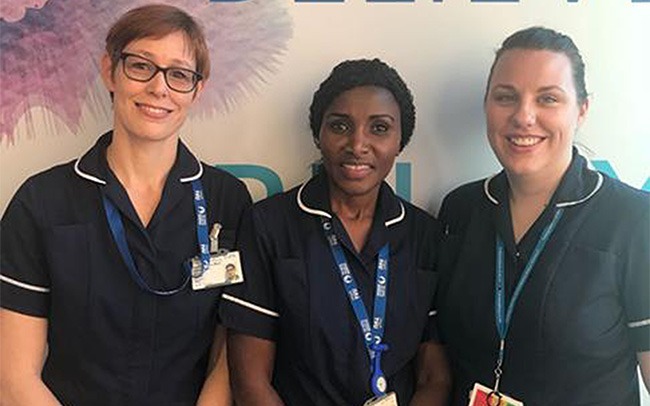
You will meet several midwives throughout your pregnancy, birth and beyond. Midwives are the main caregiver when your pregnancy and birth are straight forward. We are working hard to ensure each woman has a named midwife who is responsible for coordinating your maternity care.
Obstetrician
These are doctors who specialise in caring for women during pregnancy, birth and the period immediately after birth (whilst in the maternity unit). You may see an obstetrician during pregnancy if you have any issues which require review or more specialised management and they will be involved if you have a caesarean or assisted birth.
Paediatrician/Neonatalogist(baby doctor)
Paediatricians or neonatologists are doctors specialising in the care of newborn babies and children. They will be involved in your care if early (premature) delivery is anticipated or if there are likely to be concerns about the health of your baby during or after the birth.
Sonographer
These are professionals who undertake your ultrasound scans. They are specially trained to undertake scans during pregnancy.
Maternity support worker
You may meet maternity support workers during pregnancy, birth and beyond. They support the maternity team and provide some of your care throughout the journey.
Student midwife
Maternity units in Lincolnshire Maternity and Neonatal System work closely with local universities to support midwives and doctors in training. These students will work alongside their midwife ‘mentor’ and will ask for your consent before providing you with any care.
Health Visitor
Health visitors work in teams. They work closely with the other professionals listed above, including GPs and organisations that support families where you live. Most families in England will be offered several review contacts and additional support depending on the individual needs of your family.
A ‘Primary Birth’ conversation should take place between 10-14 days after your baby’s birth however, due to current staffing pressures, this might take place slightly later. You should expect a call from your health visitor within the first couple of days of being home with your baby.
Other team members
You may meet other members of staff and medical students, depending on your pregnancy needs and where you choose to have your care.
Our objective
Lincolnshire Local Maternity & Neonatal System is introducing recommendations from the Better Births, National Maternity Review.
Published in 2016, the review aims to ensure that maternity services in England be "safer, more personalised, kinder, professional and more family friendly; where every woman has access to information to enable her to make decisions about her care; and where she and her baby can access support that is centred around their individual needs and circumstances".
The achievements in our local area can be seen in these short films:
{‘hospitals’:[{‘slug’:’hospital-diana-princess-of-wales-hospital’,’name’:”Diana Princess of Wales Hospital”,’imageurl’:’http://mumandbabyv4.imagineear.com/wp-content/uploads/2020/10/Diana-Princess-of-Wales-Hospital.jpg’,’id’:0,’coordinate’: {‘latitude’:53.5449,’longitude’:-0.095317}},{‘slug’:’hospital-lincoln-county-hospital’,’name’:”Lincoln County Hospital”,’imageurl’:’http://mumandbabyv4.imagineear.com/wp-content/uploads/2020/07/lincoln-county.jpg’,’id’:1,’coordinate’: {‘latitude’:53.2336,’longitude’:-0.519415}},{‘slug’:’hospital-peterborough-city-hospital’,’name’:”Peterborough City Hospital”,’imageurl’:’http://mumandbabyv4.imagineear.com/wp-content/uploads/2020/10/Peterborough_City_Hospital.jpg’,’id’:2,’coordinate’: {‘latitude’:52.5842,’longitude’:-0.278339}},{‘slug’:’hospital-pilgrim-hospital’,’name’:”Pilgrim Hospital”,’imageurl’:’http://mumandbabyv4.imagineear.com/wp-content/uploads/2020/10/Pilgrim-exterior_landscape-1024×683.jpg’,’id’:3,’coordinate’: {‘latitude’:52.9910,’longitude’:0.0106}}]}
Being pregnant increases your risk of developing deep vein thrombosis (DVT), with the highest risk being after you have had your baby. However, a DVT can occur at any time during your pregnancy, including the first three months of pregnancy.
Signs/symptoms
Pain/tenderness in the leg behind the knee or in the calf.
Feeling of heat in the affected area or a red discolouration of the skin.
Swelling of the affected area.
A pulmonary embolism may cause shortness of breath and chest pain, which comes on suddenly and worsens with deep breaths, coughing or chest movement.
If you have any of these symptoms you should speak to a health professional immediately, or attend your local A&E department.
Treatment
These conditions are serious and will require urgent treatment in hospital with medications that prevent the clot from getting bigger and breaking off and travelling to another part of the body.
Wear compression stockings if your midwife or doctor have advised you to do so.
Consider taking short walks when you feel up to it.
Stay well hydrated.
Avoid sitting/lying down for prolonged periods, ie, in a car/on a train.
Staff use a venous thromboembolism risk scoring system at your Booking appointment to determine your risk during pregnancy. Read the related links to find out what conditions can increase the risk of a DVT during pregnancy.
Altough rare, listeriosis infection in pregnancy can lead to miscarriage, stillbirth or severe illness in newborn babies. Listeria can be found in unpasteurised milk and in many chilled foods including pâté.
Transitional care is when you and your baby stay together in hospital with support from the hospital staff. It means that your baby is well enough to stay with you either on the postnatal ward or a room near the neonatal unit. You will be in hospital with your baby. Common reasons for a baby requiring transitional care include:
babies born early between 33 and 35 weeks
babies with jaundice requiring treatment
babies needing antibiotic treatment
babies requiring extra support with their feeding.
Your baby will be reviewed regularly by one of the neonatal doctors or nurses whilst they are in transitional care and the treatment plan will be discussed with you.Some babies may need more care than can be provided on the postnatal ward or in transitional care and they are admitted to the neonatal unit. The main reasons for a baby to be admitted are that they are born prematurely, have a low birth weight or have a specific medical condition which needs treatment in hospital. When your baby is admitted one of the neonatal team will be able to update you on your baby’s condition and progress. You will be able to visit your baby at any time on the neonatal unit.Neonatal care is organised across the country in regional networks of neonatal units. The units provide different levels of care to babies depending on how early or unwell they are.If there is a suspicion that your baby will need a higher level of care than the hospital you are in can provide, you may be moved to a different hospital before your baby is born. This is called “In-utero transfer” (your baby is still in your uterus). If the move happens after your baby is born because they have arrived earlier than expected or are unwell, this is called “ex-utero transfer”. The neonatal team will always ensure that you and your baby are not separated for any longer than is necessary.There are three types of neonatal unit, which provide different levels of care depending on what your baby needs. These are:Special Care Baby Unit (SCBU): the care provided here is usually for babies born after 32 weeks gestation, or babies who only require a low level of support, such as some oxygen or a drip for a short time.Local neonatal unit (LNU): the level of care provided here is for babies who need more support than those in a SCBU, as they are born betwen 28 and 32 weeks gestation or are unwell and may require a short period of intensi ve care or high dependency care, including help with breathing.Neonatal Intensive Care Unit (NICU): this is for babies born earlier than 28 weeks gestation or those who are very unwell for other reasons. The NICU can look after babies of all gestations and is sometime called a “tertiary” unit. Some of these units specialise in surgery for baby or other types of highly specialised care. If your baby needs to be in a NICU, they will usually need to be on a breathing machine (ventilator).If your baby needs to be transferred to another hospital after birth, the Neonatal Transport Service will come and look after your baby and transfer them to the new hospital. If you are well enough to be discharged you will be able to meet your baby at the new hospital. If you are not well enough suitable arrangements will be made for your ongoing care.When your baby is well enough they will be moved back to the hospital that is closer to your home. This allows you and your baby to get to know the team who will be looking after them once they are discharged home.
Paediatricians or neonatologists are doctors specialising in the care of newborn babies and children. They will be involved in your care if early (premature) delivery is anticipated or if there are likely to be concerns about the health of your baby during or after the birth.
There are eight small bones called the carpal bones in the wrist. These bones form a semi-circle, and a tough band of tissue (the carpal ligament) forms a roof over these bones. This tunnel is known as the ‘carpal tunnel’. Passing through this tunnel are the tendons which move the fingers and thumb and the median nerve. When the median nerve gets compressed (squeezed or pinched) in the tunnel, it causes the symptoms of CTS.During pregnancy, the body naturally retains more fluid, and swelling of the hands is common. If some of this fluid is localised to the carpal tunnel, this leads to pressure on the median nerve causing the symptoms of CTS. Up to 62% of pregnant women develop CTS. These symptoms are also common after the birth.
What are the common symptoms?
Symptoms are commonly felt in the thumb, index and middle fingers. You may have symptoms in one or both hands.Symptoms may include:
pain in your wrist, palm or forearm
‘pins and needles’
numbness
weakness caused poor grip or clumsiness
burning sensations in the fingers
hands may appear swollen
Symptoms may be worse at night and cause you to wake up and worse thing in the morning. This may be due to sleeping position, and/or relaxation of the muscles that act during the day to redistribute the fluid to the rest of the body.
What can you do to help yourself?
Positioning
Keep your wrists straight to avoid putting pressure on the nerve. You may find wearing a wrist splint useful at night and when resting during the day. Do not put splints on too tightly and do not wear them continuously unless advised.
Rest
Reduce all non-essential activities, such as shopping, carrying, lifting and repetititve tasks such as typing and writing.
Ice
Using an ice pack over the wrist/hand area may help reduce the swelling and pain. Leave for 10 minutes.
Contrast bathing
Using alternating heat and cold can also be helpful to reduce pain and swelling. You can do this by either using an ice pack and hot water bottle wrapped in a tea towel or by dipping your hands in cold or warm water. Alternate between warm and cold for 30 seconds each, for 5-6 minutes, always finishing with the cold. You can do this 3-4 times a day. Precaution: always check the water temperature before immersing your hand.
Elevation
When possible, place your wrists on pillows above the level of your heart to reduce swelling. This can be very useful at night – remember not to sleep with your hands under your pillow.
Movement/Exercise
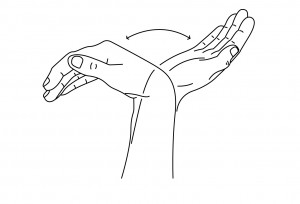
These exercises done throughout the day between rest periods may help relieve your symptoms. Aim to do the exercises at least three times every day.1. Bend and straighten your wrists keeping your fingers straight. Hold each position for 5 seconds and repeat x10:2. Hand squeeze. Make a release a fist (this can be done with your hands elevated). You could also squeeze a stress ball:3. Fingers bend and straighten. Forearm upright, wrist and fingers straight. Now hook your fingers down, trying to touch the tips of your fingers to the top of your palm. Straighten again. Repeat 10 times:
General advice
Should your symptoms continue after your baby is born you should speak to your GP who may refer you for assessment and care.
Babies are learning from adults as soon as they are born. At this age, your baby will love when you chat, play, sing and read to them, even when they are too young to understand everything.
Chat
Your baby starts trying to communicate with you from day one. You can practise communicating together to build your bond and help them develop. Your baby loves the sound of your voice, so little chats throughout the day will make them happy.
Play
Your baby starts exploring the world straightaway through movement, sights and sounds. Playing helps your baby get stronger, become more coordinated and learn new things.
Sing
Babies who are exposed to and engage in music, singing and rhyming regularly with parents and carers learn to speak more easily. They have more words to express themselves and are more confident and creative. Babies like hearing songs and rhymes over and over again.
Read
Reading to your baby has many benefits long before they can read or understand words. Your voice stimulates their brain and your voice is soothing to them.
What to expect at six months
Babies develop at different rates. However, understanding what is typical ccan help you identify speech and language problems early. By six months, children will usually:
Turn towards a sound/voice when they hear it.
Be startled by loud noises.
Watch your face when you talk to them.
Recognise your voice.
Smile and laugh when other people smile and laugh.
Make sounds to themselves, like cooing, gurgling and babbling.
Make noises, like coos and squeaks, to get your attention.
Have different cries for different needs. For example, one cry for hunger, another when they are tired.
Also remember to eat foods that are rich in dietary iron (see related link below). If exhaustion persists for more than a few days speak to your midwife or GP.

 These short videos have been designed to help those women and their partners who are unable to attend antenatal classes in person.